

 ABK
ABK Alphacool
 Aqua Computer
 Aqua Tuning
 Arctic
 Barrow
 Barrowch
 EKWB
EKWB Hardware Labs
 Kingpin Cooling
 Phobya
 Prolimatech
 Thermal Grizzly
 Watercool
Water Cooling
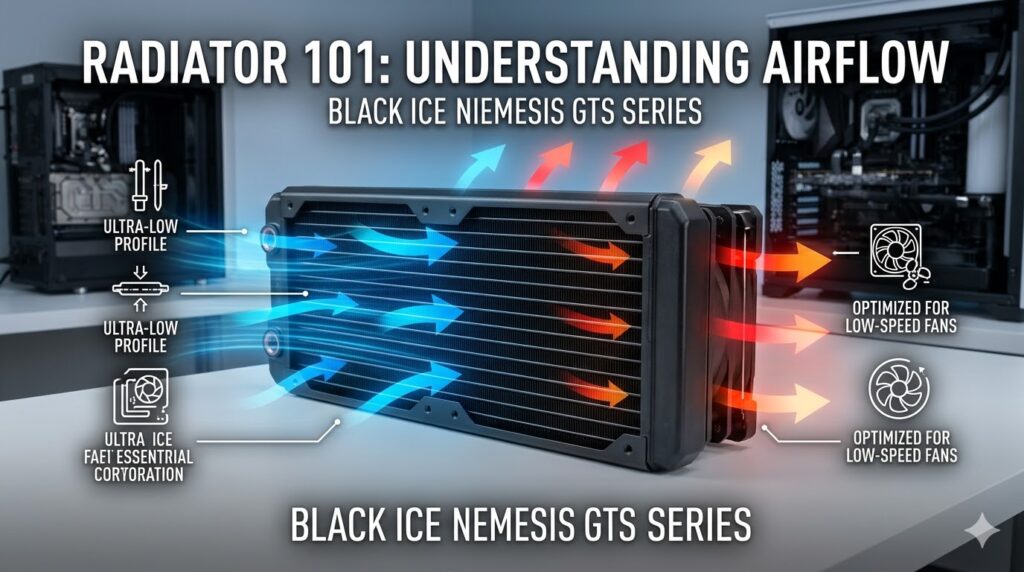
Radiator 101: Understanding Airflow with the Black Ice Nemesis GTS Series
12
Mar
Mar
Welcome back to the FTC Water Cooling blog! If you are diving into the world of custom loops, you already know that your radiator is the unsung hero of your rig. It is the lungs of your cooling system, responsible for taking all the heat dumped by your CPU and GPU and exhausting it from your case.
But picking a radiator is not just about finding one that fits your case; it is about understanding airflow. Today, we spotlight a legendary piece of hardware in the water cooling community: the Hardware Labs Black Ice Nemesis GTS Series.
Let’s break down exactly how airflow works with this specific radiator and why it might be the perfect fit for your next build.
The Basics: Why Airflow Matters
Before we talk about the Nemesis GTS, we need to understand the relationship between three crucial factors in any water cooling loop:
- Thickness: Radiators generally range from slim (~30mm) to extremely thick (60mm+).
- FPI (Fins Per Inch): This measures how densely packed the copper or brass fins are inside the radiator housing. Higher FPI means more surface area for cooling, but it requires more force to push air through.
- Static Pressure vs. Airflow: Standard case fans are designed to move a high volume of air (Airflow/CFM). Radiator fans, however, need Static Pressure (mmH2O) to forcefully shove air through the dense fin arrays without the air bouncing back.
The golden rule of radiators? Thick radiators with high FPI require high-speed, high-static-pressure fans. This usually translates to a louder PC.
Enter the Black Ice Nemesis GTS
The Black Ice Nemesis GTS flips that golden rule. At just 29.6mm thick, it is designed for builders who want top-tier cooling performance without their PC sounding like a jet engine.
Here is why the airflow dynamics of the GTS series are so unique:
1. The “Supercruise” Advantage
Hardware Labs engineered the Nemesis GTS with what they call “Supercruise” optimizations. This means the radiator’s copper fin array is specifically tuned to operate at peak efficiency with ultra-low fan speeds, specifically in the sub-800-RPM range.
While other radiators lose a massive amount of cooling capacity when you turn your fans down to whisper-quiet levels, the GTS thrives. It maximizes heat dissipation even when the air moving through it is relatively slow.
2. 16 FPI with a Twist
The GTS features a 16 FPI fin density, which is moderate. Hardware Labs uses ultra-thin copper fins that provide the surface area of a much denser radiator without extreme airflow restriction. Your fans do not have to fight to push air through the core, which reduces turbulence and noise.
3. High Flow Restriction vs. Airflow
A quick caveat for loop planning: While the Nemesis GTS is very unrestricted for airflow, it is somewhat restrictive for water flow. If you run multiple GTS radiators in a single loop, make sure you have a reliable D5 or DDC pump to keep your coolant moving efficiently.
Setting Up Your Fans: Push, Pull, or Push/Pull?
How should you configure your Nemesis GTS fans for optimal airflow?
- Push Configuration (Recommended): The fans sit in front of the radiator, pushing fresh air through the fins. Because the GTS is only about 30mm thick and optimized for low airflow, a standard Push configuration with a good static pressure fan (like a Noctua NF-A12x25 or Phanteks T30) is all you need.
- Pull Configuration: Fans sit behind the radiator, pulling air through. This performs almost identically to Push and is great if it improves your case lighting or aesthetics.
- Push/Pull Configuration: Fans on both sides of the radiator. For the Nemesis GTS, this is usually overkill. Because the radiator is thin and unrestrictive to air, adding a second set of fans yields negligible temperature drops (maybe 1-2°C at best) while taking up more space and adding cable clutter. Save your money.
The Verdict
If your goal is to build a sleek, compact, and silent PC that still offers enthusiast-level cooling, the Black Ice Nemesis GTS Series is a masterclass in airflow engineering. It proves you do not need a 60mm thick radiator and roaring 2000 RPM fans to keep your overclocked hardware in check.
Ready to start planning your loop? Head over to the FTC Water Cooling Store to check out the Black Ice Nemesis GTS series in 120mm, 240mm, 360mm, and 480mm sizes!
