

 ABK
ABK Alphacool
 Aqua Computer
 Aqua Tuning
 Arctic
 Barrow
 Barrowch
 EKWB
EKWB Hardware Labs
 Kingpin Cooling
 Phobya
 Prolimatech
 Thermal Grizzly
 Watercool
Uncategorized
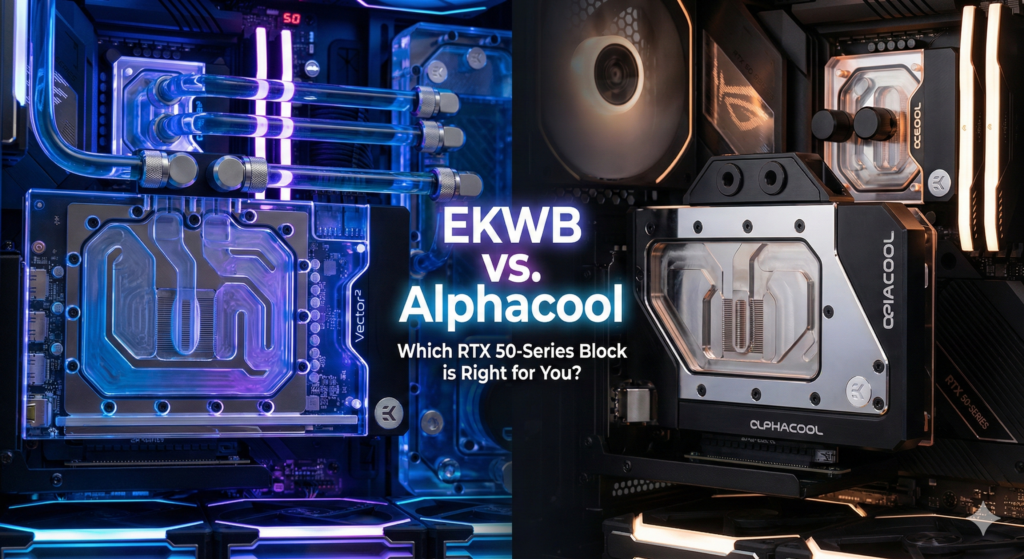
EKWB vs. Alphacool: Which RTX 50-Series Block is Right for You?
Jan
The rumor mill has finally ground to a halt, and the reality of Nvidia’s RTX 50-series “Blackwell” architecture is looming. We know two things for certain: these cards are going to offer blistering performance, and they are going to demand serious power.
If you’ve seen the leaked images of the reference air coolers, you know they are reaching comical sizes. A four-slot behemoth hanging off your motherboard isn’t just unsightly; it’s inefficient for a true enthusiast build.
Once again, custom watercooling isn’t just a luxury upgrade for the top-tier GPU—it’s practically a necessity for unlocking sustained boost clocks without turning your PC into a space heater.
At FTC Watercooling, we are gearing up for the launch, and the two biggest questions we get are always the same: “When can I pre-order?” and “Should I get EK or Alphacool?”
Today, we’re breaking down the eternal rivalry between Slovenia’s EKWB and Germany’s Alphacool based on their current design philosophies to help you decide which block deserves to cool your future RTX 5080 or 5090.
The Contenders at a Glance
Before we dive into the specifics of their 50-series designs, let’s establish the current reputation of these two titans.
EKWB (EK Water Blocks): The Premium Trendsetter Hailing from Slovenia, EK has long been the “poster child” of modern PC watercooling. They focus heavily on premium aesthetics, intricate machining, integrated D-RGB lighting, and creating a cohesive ecosystem (Matrix7). If you want your build to look like a futuristic hypercar, EK is usually the first stop.
Alphacool: German Engineering & Value Alphacool has traditionally been the pragmatic choice. Known for industrial reliability, high compatibility, and excellent performance-per-dollar, they have been the go-to for experienced builders focused on function. However, their recent “Core” series has seen a massive leap in aesthetic quality, challenging EK on looks while maintaining competitive pricing.
Deep Dive: The EKWB Approach to the 50-Series
If the RTX 40-series “Quantum Vector²” blocks are any indication, EK’s offering for the 50-series will be nothing short of spectacular—and enormous.
EK has doubled down on a “maximalist” approach. Their recent high-end GPU blocks are heavy, featuring thick copper cold plates and massive acrylic tops that act as huge diffusers for the dense D-RGB LED strips embedded within.
The Pros:
- Unmatched Aesthetics: If you love the “glass and light” look, nobody does it better. The polish on the nickel plating and the clarity of the acrylic are top-tier.
- The Ecosystem (Matrix7): If you are using EK reservoirs, radiators, and fittings, their “Matrix7” standard simplifies tubing runs by standardizing heights and port distances. It makes building clean, parallel loops much easier.
- Active Backplate Options: EK pushed hard on active backplates (cooling the rear PCB components with liquid) during the 30 and 40 series. For a power-hungry 5090, this might offer a slight edge in memory junction temperatures.
The Cons:
- The “EK Tax”: You pay a premium for the brand name and the looks.
- Complexity: Their recent blocks often require very specific thermal pad placement and thickness, making installation slightly more nerve-wracking for beginners compared to the competition.
Deep Dive: The Alphacool Approach to the 50-Series
Alphacool has undergone a renaissance. Gone are the days of purely utilitarian, slightly rough-around-the-edges blocks. Their “Core” and “Eisblock Aurora” lines have brought sleek, modern design to the forefront without sacrificing their engineering roots.
We expect their 50-series blocks to continue the trend of using chrome-plated copper (which is incredibly durable and shiny) rather than standard nickel plating, alongside brass tops instead of just acrylic or acetal on some models.
The Pros:
- Material Durability: Alphacool’s recent shift toward chrome plating is a winner. It is harder than nickel and more resistant to scratches or flaking over long periods.
- Performance Value: Historically, Alphacool blocks perform within a 1–2°C margin of EK blocks but often cost significantly less. The price-to-performance ratio is hard to beat.
- Forgiving Installation: Alphacool tends to use softer thermal pads that are more forgiving if your mounting pressure isn’t perfectly uniform, making installation slightly less stressful.
The Cons:
- Aesthetic Simplicity: While much improved, their RGB implementation is usually subtler than EK’s “in-your-face” light show.
- Less “Ecosystem” Focus: While their parts work great together, they don’t have a rigid system like Matrix7 designed to line up ports perfectly for hardline tubing.
The Head-to-Head Verdict: Which one for your RTX 5090?
When you are spending upwards of $1,500 on a GPU, the cost of the block becomes secondary to peace of mind and satisfaction. Here is how we break down the choice at FTC Watercooling:
1. Thermal Performance
Winner: Tie (Functional Dead Heat) Honestly, at this level, the difference in GPU core temperature between an EK Quantum Vector and an Alphacool Eisblock on an RTX 50-series card will likely be negligible—perhaps 1 to 2 degrees Celsius at most. Both use massive copper cold plates and jet impingement engines capable of handling 500W+ loads easily. Don’t base your decision solely on thermal benchmarks; they are both excellent.
2. Aesthetics and RGB
Winner: EKWB (For Maximum Flash) / Alphacool (For Clean Elegance) This is subjective. If you want your PC to be the centerpiece of a rave, EK’s edge-to-edge lighting and highly polished acrylic win. If you prefer a sophisticated, heavier, industrial look with chrome accents and subtler lighting, Alphacool’s recent designs are stunning.
3. Installation and Compatibility
Winner: Alphacool Alphacool generally provides instructions that are easier to follow and thermal pad schemes that are more forgiving. They also tend to release blocks for a wider variety of AIB partner cards (like Zotac, Palit, etc.) faster than EK, who focus heavily on Founders Edition and ASUS/MSI initially.
4. Price
Winner: Alphacool Almost universally, the Alphacool equivalent block will be cheaper than the EKWB option, sometimes by a significant margin, leaving you more budget for better fittings or more coolant.
The FTC Final Conclusion
At FTC Watercooling, we stock both brands heavily because they serve slightly different customers, even though they both provide top-tier cooling.
Choose EKWB for your RTX 50-Series if: You are building a showcase PC where aesthetics are paramount. You are willing to pay a premium for the best possible RGB integration and the prestige of the brand, and perhaps you are already invested in the EK Matrix7 ecosystem.
Choose Alphacool for your RTX 50-Series if: You want the best possible performance-per-dollar without sacrificing build quality. You appreciate durable materials like chrome plating, prefer a cleaner look over maximum RGB, or need a block for a less common AIB card model.
