

 ABK
ABK Alphacool
 Aqua Computer
 Aqua Tuning
 Arctic
 Barrow
 Barrowch
 EKWB
EKWB Hardware Labs
 Kingpin Cooling
 Phobya
 Prolimatech
 Thermal Grizzly
 Watercool
Best Thermal Paste for Watercooling
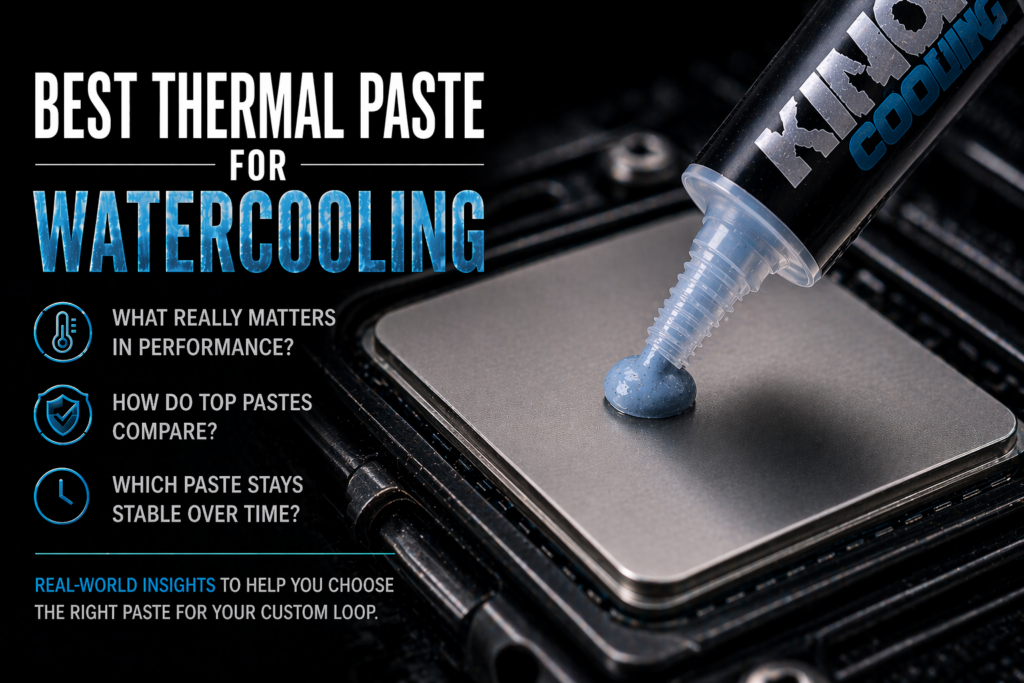
Choosing the best thermal paste for a custom watercooling build isn’t about chasing the highest benchmark numbers—it’s about long-term reliability, consistent performance, and proper application.
While many high-end thermal compounds perform very closely in controlled testing, real-world results often depend more on how well the paste is applied and how it holds up over time inside your system.
This guide breaks down what actually matters when choosing thermal paste for watercooling—and how to pick the right option for your build.
Quick Answer
For most custom watercooling systems, high-quality thermal pastes perform nearly identically in raw temperatures. The biggest differences come down to ease of application, long-term stability, and consistency over time.
Real-World Performance vs Benchmarks
Many comparison charts show small temperature differences between top thermal pastes—often just a few degrees under controlled conditions.
In real-world custom loops, those differences are usually negligible. Factors like mounting pressure, application technique, and long-term stability tend to have a much bigger impact on performance than the specific paste used.
That means a well-applied, stable thermal paste will almost always outperform a higher-rated paste that is applied poorly or degrades quickly.
When choosing the best thermal paste for watercooling, it’s important to focus on real-world performance rather than just benchmark results.
What Actually Matters in Thermal Paste for Watercooling?
- Application Consistency: Smoother pastes are easier to apply evenly, helping ensure proper contact between your processor and cooling block.
- Long-Term Stability: A good thermal compound should resist drying out and maintain performance over time.
- Pump-Out Resistance: Repeated heating and cooling cycles can cause some pastes to shift or degrade. Stability here is key—especially in custom loops.
- Reliable Real-World Performance: Consistent performance over time is more valuable than small differences in synthetic benchmarks.
High-End Thermal Paste Comparison (Simplified)
Most premium thermal pastes fall into a very similar performance range. The real differences tend to show up in usability and long-term behavior rather than raw temperature results.
- Kingpin KPx: Known for smooth application and strong long-term stability. Popular among enthusiasts who want consistent results without frequent maintenance.
- Thermal Grizzly Kryonaut: High-performance paste that performs well in testing, but can require more careful application and handling.
- Arctic MX-6: A solid, widely available option that balances performance and ease of use at a lower price point.
For custom watercooling builds, the difference between these options is typically very small in terms of temperature—but noticeable in how they behave over time.
Many independent benchmarks, such as those published by hardware review sites, show only small differences between high-end thermal pastes.
Why Thermal Paste Still Matters in a Custom Loop
Even with a high-end radiator, quality fans, and a strong pump setup, your system still depends on efficient heat transfer at the CPU or GPU contact point.
Thermal paste fills microscopic gaps between surfaces, allowing heat to move efficiently into the cooling block. Without it, air pockets can form and reduce cooling performance significantly.
A Strong Option for Custom Watercooling Builds
For builders who want a thermal paste that is easy to work with and reliable over time, Kingpin KPx is a strong option.
It’s widely used by enthusiasts due to its smooth application, consistent coverage, and long-term stability—making it especially well-suited for custom loops where minimizing maintenance is important.
👉 Shop Kingpin KPx Thermal Paste
Want a Deeper Comparison?
If you’re deciding between top-tier options, check out our full comparison:
👉 Kingpin KPx vs. Thermal Grizzly
This guide breaks down real-world performance, application differences, and what actually matters for custom watercooling systems.
Browse All Thermal Paste Options
If you want to compare multiple brands and find the right fit for your build:
👉 Browse all thermal paste options
FAQ: Best Thermal Paste for Watercooling
Does thermal paste matter in watercooling?
Yes. Even in a custom loop, thermal paste is critical for transferring heat efficiently from your CPU or GPU into the cooling block.
Is the highest-rated thermal paste always the best?
Not necessarily. In real-world builds, application quality and long-term stability often matter more than small differences in thermal conductivity ratings.
How often should I replace thermal paste?
Most high-quality thermal pastes last 1–2 years or longer depending on system use and temperatures.
What matters most when applying thermal paste?
Even coverage and proper mounting pressure are more important than the specific brand used.
What is the best thermal paste for a custom loop?
The best option is a high-quality paste that applies evenly, stays stable over time, and delivers consistent performance in real-world conditions.