

 ABK
ABK Alphacool
 Aqua Computer
 Aqua Tuning
 Arctic
 Barrow
 Barrowch
 EKWB
EKWB Hardware Labs
 Kingpin Cooling
 Phobya
 Prolimatech
 Thermal Grizzly
 Watercool
Guides
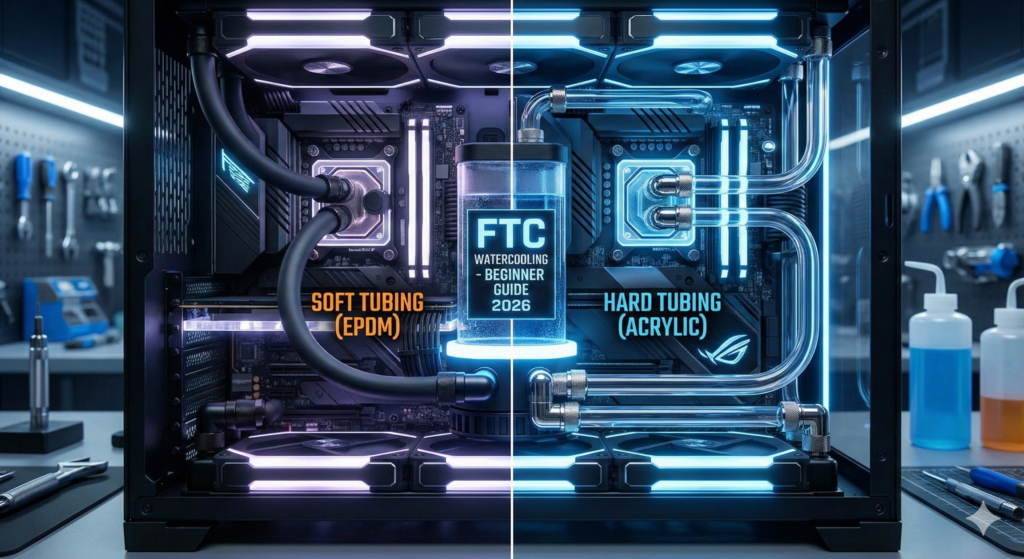
Beginner Guide: Soft Tubing vs. Hard Tubing – What’s Best for Your First 2026 Build?
Jan
The Great Debate: Entering the World of Custom Loops
So, you’ve finally decided to take the plunge. You’ve got a beastly GPU that’s practically begging for better thermals, and you’re tired of the noise your AIO pump makes. Welcome to the world of custom watercooling in 2026.
Building your first custom loop is one of the most rewarding experiences in PC building. It’s superior cooling, near-silent operation, and unparalleled aesthetics all rolled into one. But before you start adding blocks and radiators to your FTC cart, you have to make the single biggest decision of your build—one that dictates your tools, your fittings, and your entire assembly process:
Soft Tubing or Hard Tubing?
If you’re a beginner looking to build your first loop in 2026, the landscape has changed slightly from five years ago. Materials are better, fittings are more secure, and hardware is denser than ever.
In this guide, we’re breaking down the pros, cons, and realities of both tubing types to help you decide which path is right for your very first custom loop.
Soft Tubing: The “Forgiving” Route
For decades, soft tubing was the default entryway into watercooling. In 2026, it remains the most practical choice for beginners, but “practical” doesn’t have to mean “ugly.”
Soft tubing is exactly what it sounds like: flexible PVC, silicone, or rubber tubing that bends easily and connects components with compression fittings or barbs.
The Pros of Soft Tubing
-
Zero Thermal Tools Required: You don’t need heat guns, mandrels, or saws. A good pair of tubing cutters (or even heavy-duty scissors in a pinch) is all you need to resize your runs.
-
Ideally “Forgiving”: This is the biggest selling point for a first-timer. Did you cut that tube 4mm too long? It’s fine; it’ll just bow out slightly. Did you miscalculate an angle? The tubing will flex to meet the fitting. It significantly reduces build anxiety.
-
Easier Maintenance: Need to swap out your RAM or access your M.2 drive? With soft tubing, you can often unmount the CPU block and gently move it aside without draining the entire loop. Try doing that with rigid pipes.
-
Lower Cost of Entry: The tubing itself is cheaper, and you don’t need to buy a $100 bending kit to get started.
The Cons of Soft Tubing
-
The “Droop”: Over time, especially in warmer loops, clear PVC tubing can soften and sag, losing that tight, clean look.
-
Plasticizer Leeching & Clouding: While 2026 formulations are better, clear soft tubing eventually gets cloudy or yellowed as the plasticizers (the chemicals that make it flexible) leach out into your coolant. This requires more frequent tubing replacements to keep it looking fresh.
-
Kinking: If you try to make too tight of a turn, the tube will kink like a garden hose, cutting off flow. You need to use angled adapters to manage tight bends.
The 2026 Perspective: The Rise of EPDM
If you choose soft tubing today, forget the clear stuff. The current meta for modern, high-end soft tube builds is EPDM (Ethylene Propylene Diene Monomer).
Often sold as “ZMT” (Zero Maintenance Tubing), this industrial-grade, matte black rubber tubing is virtually indestructible. It doesn’t leach plasticizer, it doesn’t cloud, and it looks incredibly sleek and professional in modern blackout builds. If you want the ease of soft tubing with a pro aesthetic, EPDM is the answer.
Hard Tubing: The “Aesthetic Dream”
When you picture a jaw-dropping, Instagram-worthy custom PC, you are invariably picturing hard tubing. It involves using rigid pipes—usually Acrylic, PETG, or sometimes metal/glass—that must be heated and bent into shape or connected using varied angled adapters.
The Pros of Hard Tubing
-
Unmatched Aesthetics: This is why people do it. Perfectly parallel runs, crisp 90-degree bends, and a clean “industrial” look that soft tubing just cannot replicate. It turns your PC into an art installation.
-
No Kinking or Sagging: Once a hard tube is installed, it stays exactly where it is. It won’t droop over time, maintaining clean lines forever.
-
Material Clarity: Acrylic hard tubing is incredibly clear—almost glass-like—and stays that way. It will not yellow or cloud over time.
The Reality Check (The Cons)
-
The Learning Curve is Steep: Bending tubing requires patience, practice, and a heat gun. Your first few bends will be ugly. You will scorch tubes, you will create flat spots, and you will waste material learning the technique.
-
Zero Tolerance for Error: If your tube run needs to be 150mm and you cut it to 147mm, it will leak. There is no “wiggle room.” Precision measuring is mandatory.
-
Maintenance is a Chore: To change anything under the loop, you must drain the system and physically remove the rigid tubes blocking the way.
Acrylic vs. PETG in 2026
If you choose hard tubing, you’ll likely choose between PETG and Acrylic.
-
PETG: Easier to bend, harder to crack, but softer. Warning: With modern GPUs hitting high coolant temps, PETG has been known to deform inside the fitting if the water gets too hot, causing leaks.
-
Acrylic: Harder to bend, cracks easily if mishandled, but offers superior clarity and higher temperature resistance. In 2026, Acrylic is generally preferred for high-end builds.
Quick Comparison: The Breakdown
| Feature | Soft Tubing (EPDM/PVC) | Hard Tubing (Acrylic/PETG) |
| Installation Difficulty | Beginner Friendly (2/10) | Advanced (8/10) |
| Required Tools | Cutter only | Heat gun, saw, sandpaper, bending insert |
| Forgiveness | High (It stretches/flexes) | Zero (Must be precise) |
| Aesthetic Ceiling | Good (Great with black tubing) | Legendary (Showcase level) |
| Maintenance | Easier (Can sometimes move parts) | Difficult (Must drain/disassemble) |
| Risk of Leaks | Lower (Compression fittings grip tight) | Higher (If tube isn’t cut perfectly flush) |
The Verdict: Which Should You Choose for Your First Build?
We know those gleaming, complex hard tube builds on social media are tempting. But we also want your first experience to be positive, leak-free, and fun.
Our 2026 Recommendation for Beginners:
Start with Soft Tubing (preferably high-quality EPDM).
Here is why: The hardest part of watercooling isn’t the tubing; it’s learning how to disassemble your expensive GPU, apply thermal pads correctly, flush radiators, plan the loop order, and leak test.
By choosing soft tubing, you remove the frustration of bending from the equation, allowing you to focus on the core mechanics of the loop. You get the performance benefits immediately with a fraction of the risk. A matte black EPDM build with gorgeous nickel fittings looks incredibly premium and modern.
Choose Hard Tubing for your first build ONLY if:
-
You are incredibly patient and mechanically inclined.
-
You have the budget to buy extra tubing for the inevitable mistakes.
-
Aesthetics are 100% your top priority, superseding ease of use.
Whatever you choose, FTC Watercooling has the fittings, tubes, blocks, and coolants to make it happen.
